“My job starts where the spec sheet ends: understanding what the customer really expects, then turning it into a machine architecture that keeps up with production throughput.” Fabien Nicot, Technical Director
Every production line comes with its own constraints: a specific part, a cycle time to hit, a demanding environment, a workstation to integrate. Our SPE special-purpose machines are marking solutions and traceability systems designed and built to order, starting from your actual requirements. SIC Marking delivers both standard and custom solutions for permanent marking and component traceability.
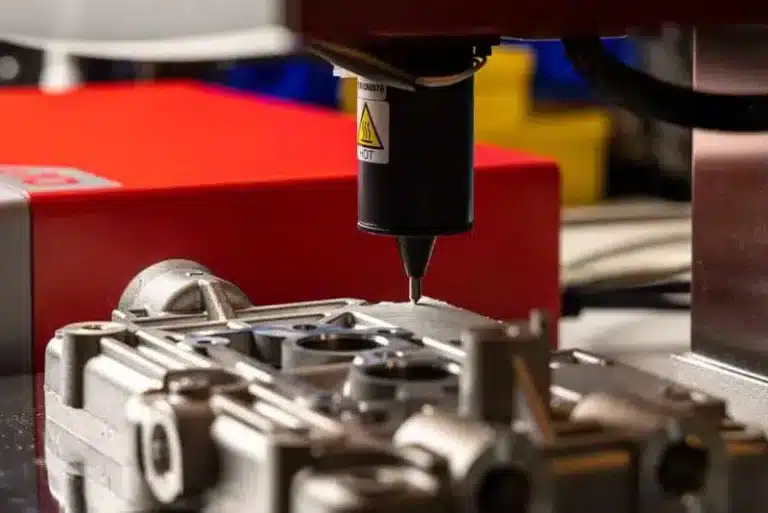
Beyond the part marking conditions themselves, the part’s own characteristics drive the choice of the most suitable marking technology (laser, dot peen or scribe marking) and of the right machine (power, speed, portability, etc.). The material, but also the treatment applied to the surface to be engraved, play a decisive role.
When the part, the cycle time, the environment or the integration fall outside what series-production equipment can handle, the special-purpose machine works the problem backwards: we define the result to be achieved, then engineer the equipment that guarantees it.
Our business here isn’t selling you a machine; it’s engineering yours. We draw on 30 years of experience in industrial marking, on every marking technology mastered by the company, and on expertise spanning all industrial sectors. Our portfolio of standard and custom solutions lets us address each customer’s specific needs, with innovations that build in the constraints of each industry.

We advise you upfront on the best-suited marking technology: the choice depends on the type of material, the accuracy required, production volume, frequency of use, marking durability, budget and environmental conditions, following a detailed analysis of your requirements. Support then continues through our network of subsidiaries and distributors, who handle promotion, implementation and customer support, as well as local deployment of the solutions.
Needs analysis: We analyze the part, the identifier, the cycle time and the environment to turn your need into a precise specification.
Design: We define the machine architecture: marking technology, mechanical design, automation and application-specific developments.
Procurement: Purchase of the standard components and of the specific or custom-made elements the machine requires.
Manufacturing: The marking machine is built, assembled and programmed in our shop, with customer sign-off.
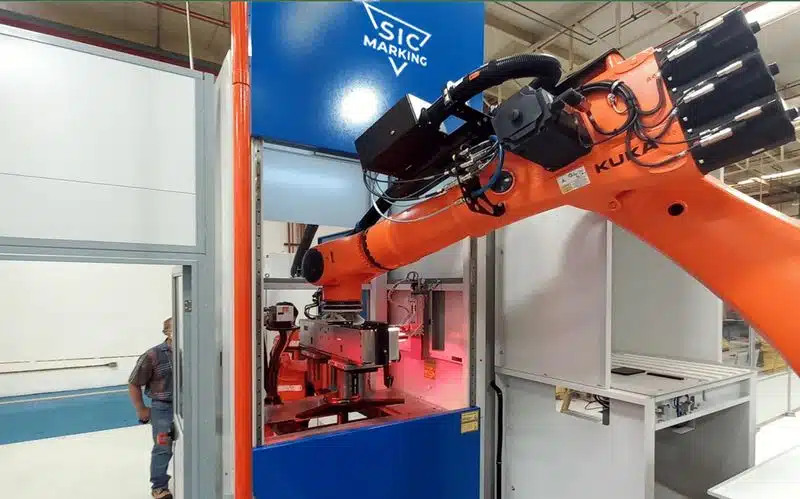
Integration: We install the machine on your line and connect it to your PLCs, your ERP and existing equipment.
Commissioning: We fine-tune and validate the industrial machine under real production conditions.
After-sales service: Training, maintenance and support keep the machine reliable over the long term.
SIC Marking masters three industrial marking technologies: dot peen, laser and scribe marking.
These technologies share one advantage: they require no consumables, labels or ink, which translates into high marking durability.
Our marking and traceability solutions meet the regulatory and standards requirements of the most demanding industries. Depending on the industry and the part involved, they fit within the following frameworks in particular:
Several application cases illustrate this custom approach, industry by industry:
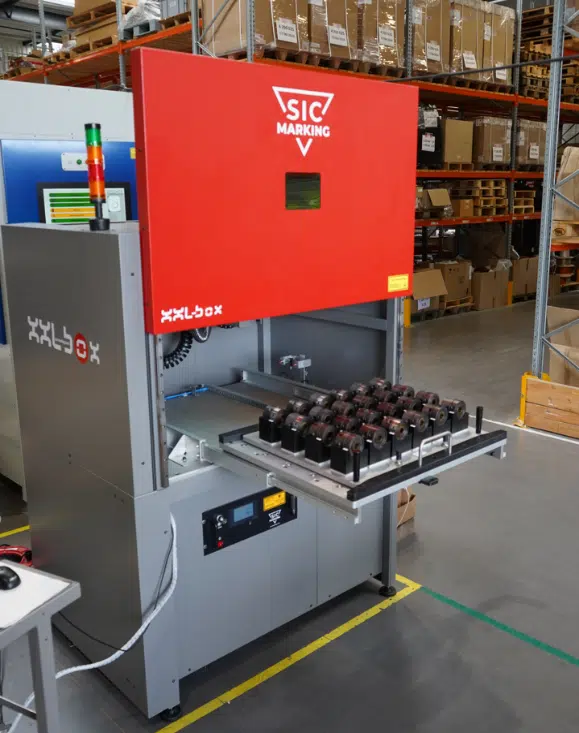
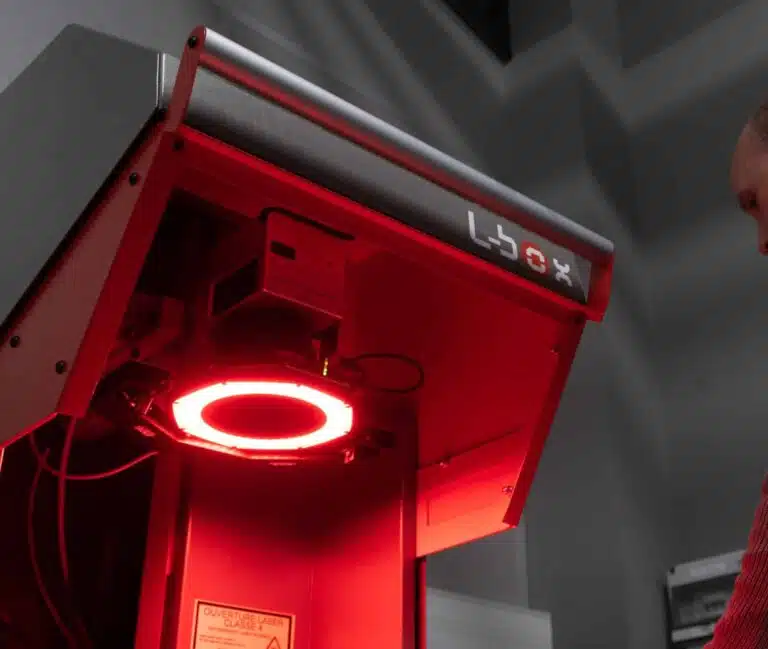
An automotive supplier wanted to automate the marking of trays of heavy parts, with three requirements: a standalone laser station integrated with its ERP for work order traceability, fast cycles with no interruptions, and an ergonomic workstation. SIC Marking supplied an XXLBOX 1200 laser station equipped with a drawer and a ball transfer table rated for up to 80 kg, precision fixtures and the SIC Factory Automation software for seamless ERP integration.

Bosch Rexroth manufactures hydraulic control valves, notably for excavator suppliers, whose machined steel spools — cylindrical parts produced in several variants — must be identified before assembly, at a rate of one tray per minute. The XXL-BOX laser station deployed automatically detects each tray via sensors, cross-checks that information against the recipe in the SIC Factory Automation software and alerts the operator in the event of a mismatch, eliminating the main source of human error without adding to the cycle time.
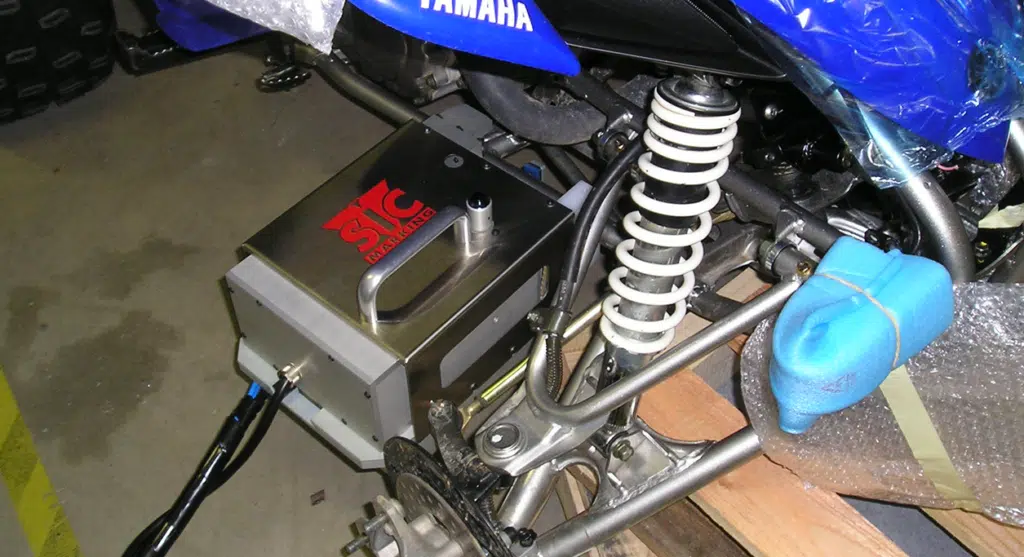
To mark the chassis number (VIN) on motorcycle, scooter and ATV frames, specific tooling had to be designed to make it easier to hold the marking gun against each area to be marked. The tooling, adapted to each area, mounts directly on the dot peen marking gun, which hangs from a tool balancer and is held against the frames by a pneumatic clamping cylinder.
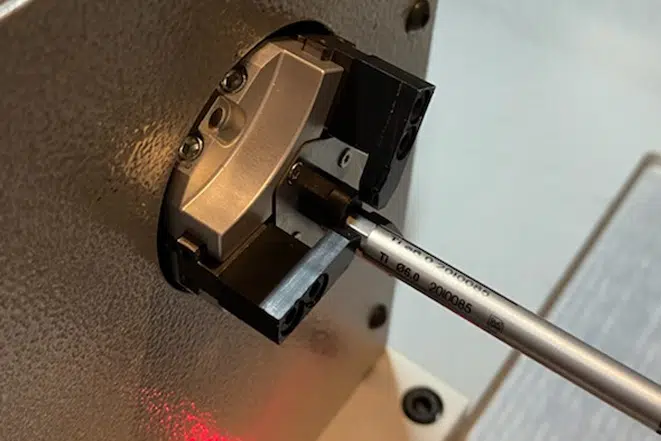
A global leader in technologies and solutions for the medical industry needed to mark implants before bending: a custom, one-off mark for a given patient, applied to straight rods before the part is formed to shape.
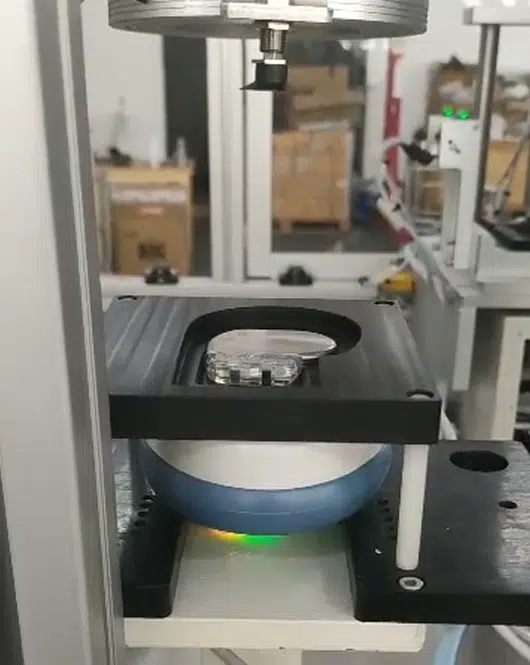
A medical device manufacturer wanted to integrate a high-throughput marking system into its production line without damaging the product’s corrosion protection; a cobot handles automatic loading and unloading of the parts.
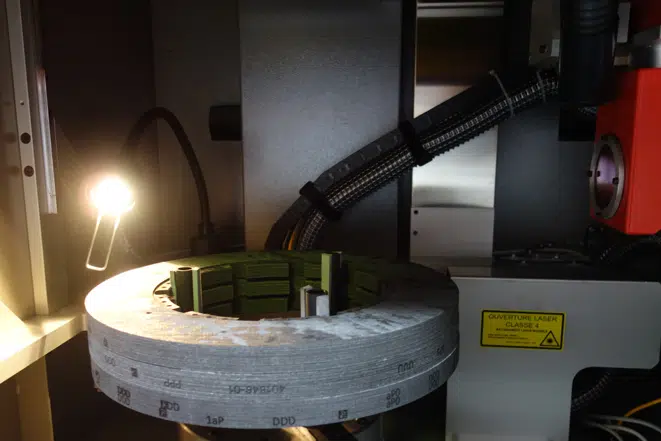
An aerospace company wanted to improve the marking of several part numbers of landing-gear carbon disc brakes: replace machined marking with laser technology and add a Data Matrix code to optimize its production process.
SIC Marking has been designing and manufacturing industrial marking solutions since 1992: the group has grown continuously by expanding into new industries, winning local and international customers and completing numerous acquisitions. Its international footprint relies on 10 subsidiaries (France, Spain, Italy, United Kingdom, Germany, Canada, United States, Mexico, China and Korea) and 40 exclusive distribution partners, serving more than 50 countries.
Every SPE machine starts with a study of your process. Our experts can recommend the best-suited solution after a detailed analysis of your requirements.
Tell us about your project
Reach out to one of our experts!