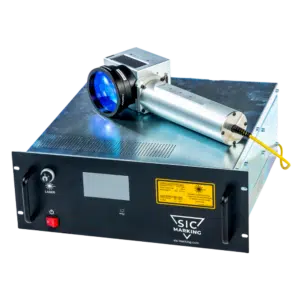
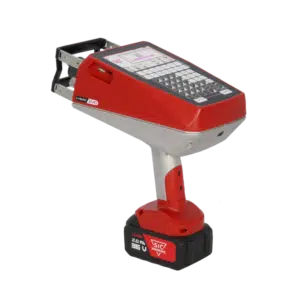
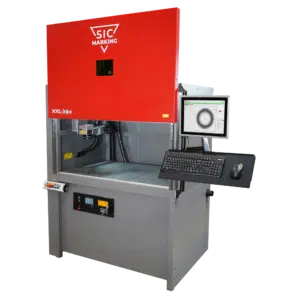
Technical materials such as carbon, titanium, special alloys, ceramics and rubber require permanent marking that does not compromise their functional properties in any way. This goes beyond surface identification — it must be approached as a durable industrial traceability solution, fully integrated into traceability workflows and regulatory compliance requirements (serial numbers, Data Matrix codes, UDI, etc.).
For materials operating under demanding conditions, permanent marking must be performed with strict precision to maintain part integrity without affecting mechanical performance.
Industrial marking technologies are selected based on material properties and application-specific requirements.
SIC MARKING offers a complete lineup of permanent marking machines, including laser marking machines, dot peen marking machines, and scribing marking machines — each engineered to address the specific requirements of technical materials, delivering marks that are durable, accurate and fully compliant with industrial traceability standards.
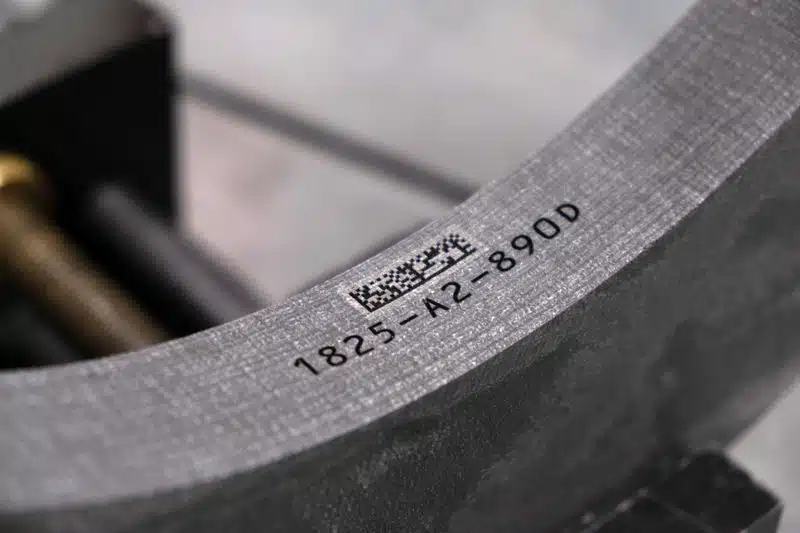
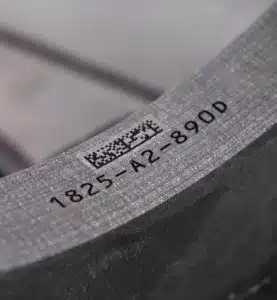
Marking carbon fiber composites (CFRP) demands advanced technological expertise. Laser marking of carbon fiber parts is the industry-standard solution, delivering permanent, non-contact marking that preserves both the polymer matrix and fiber integrity.
By contrast, mechanical marking processes such as dot peen marking and scribing marking are strongly discouraged, given the risks of delamination and crack propagation.
Laser marking of carbon delivers marks that are durable, machine-readable and compliant with the traceability and certification standards of the aerospace, medical and professional sports industries.
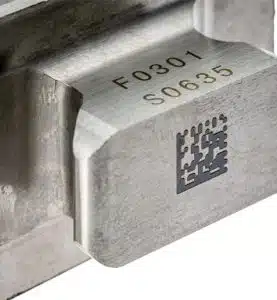
Titanium, with its high hardness, low thermal conductivity, reactivity at elevated temperatures and superior corrosion resistance, directly drives the selection and configuration of permanent marking technologies — whether laser marking, dot peen marking or scribing.
Marking titanium components requires highly precise parameter control to manage heat input and prevent heat-affected zones or crack initiation, while enabling — particularly through laser annealing marking — high-contrast marks with zero material removal. These capabilities ensure reliable, long-lasting traceability, fully aligned with the compliance requirements of the aerospace, medical and industrial sectors.
Dot peen marking technology is a go-to solution for titanium parts across the aerospace industry.
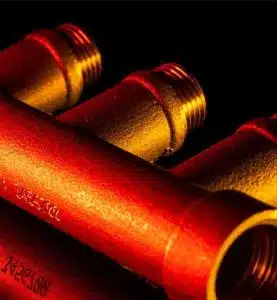
Special alloys, including marking of Inconel components, require permanent marking of the highest precision, where material properties directly determine the marking technology of choice: laser annealing marking to maintain metallurgical integrity and the passive layer, dot peen marking for maximum durability in harsh service environments, and scribing marking for specific targeted applications.
Process parameters must be validated on a part-by-part basis to prevent heat-affected zones, fracture initiation or micro-cracking, and to guarantee readability and structural performance across the full component lifecycle.
In the aerospace, medical and energy sectors, permanent marking is a critical qualification process. It incorporates testing, contrast verification and alignment with traceability standards (Datamatrix DPM, UDI), while requiring precise control of laser parameters (power, frequency, energy) to minimize heat accumulation, document process settings and ensure regulatory compliance and field performance.
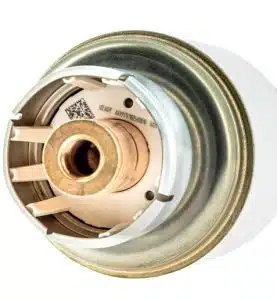
Ceramics, due to their extreme hardness, low fracture toughness and poor thermal conductivity, require non-contact permanent marking with tightly controlled energy delivery. Laser marking is the reference marking technology, utilizing short pulses with managed power and frequency to eliminate chipping, cracking and heat-affected zones.
Parameters and wavelength must be optimized for each ceramic formulation (alumina, zirconia, nitrides, carbides), with part-specific qualification trials required to confirm a repeatable, non-destructive process.
Regulatory and functional requirements (medical — UDI, aerospace, electronics) make marking qualification mandatory:
Datamatrix DPM codes and serial numbers must remain legible over time without degrading the mechanical properties of the ceramic part. Validation protocols combining visual inspection, mechanical testing and traceability documentation ensure long-term mark readability and functional integrity throughout the full service life of the component.
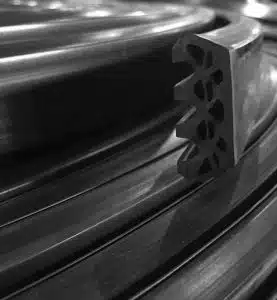
Rubber presents unique marking challenges: its high elasticity and heat sensitivity rule out aggressive mechanical marking processes, while uncontrolled energy input risks localized material degradation. Low-energy laser marking is the recommended approach, with optimized process parameters and qualification trials tailored to each compound (EPDM, NBR, silicone, FKM), ensuring long-term traceability without affecting sealing performance or the mechanical properties of the part.
Rubber combines high elasticity (elongation at break typically ranging from 200 to 800%), low stiffness, limited thermal conductivity and pronounced heat sensitivity. These properties require marking processes that impose zero mechanical stress on the component.
Permanent marking behavior varies significantly depending on compound formulation and filler content — particularly carbon black — making targeted material trials essential to achieve the required contrast, environmental resistance and regulatory compliance, while maintaining functional integrity and sealing performance.
The choice of marking technology is driven by the match between the material, the applied energy and the allowable mechanical stress thresholds.
Non-contact laser marking is the go-to solution for sensitive materials — carbon fiber composites (CFRP), technical ceramics and elastomers — eliminating any risk of mechanical stress or functional degradation.
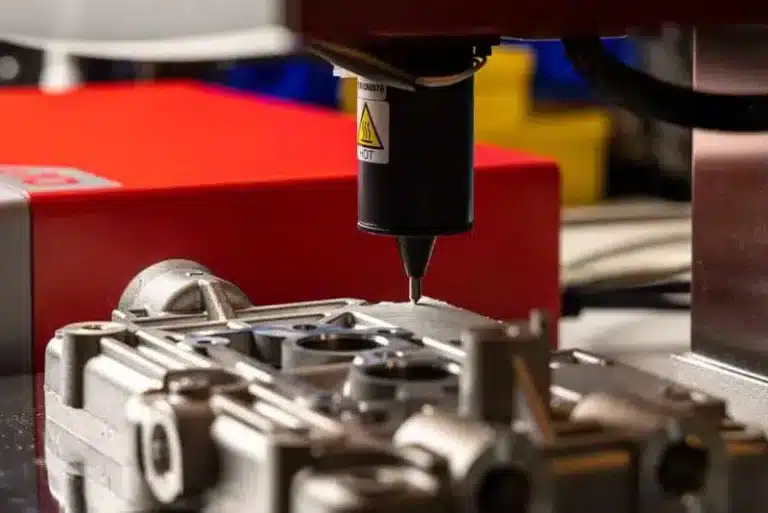
Dot peen marking (DP) is specified when deep and highly durable marks are needed, particularly on alloys exposed to severe operating conditions (Inconel, Monel), or where long-term mark retention is a critical requirement. Dot peen marking is also used for precise, low-stress marking of aerospace components, with controlled indentation depth to prevent crack initiation.
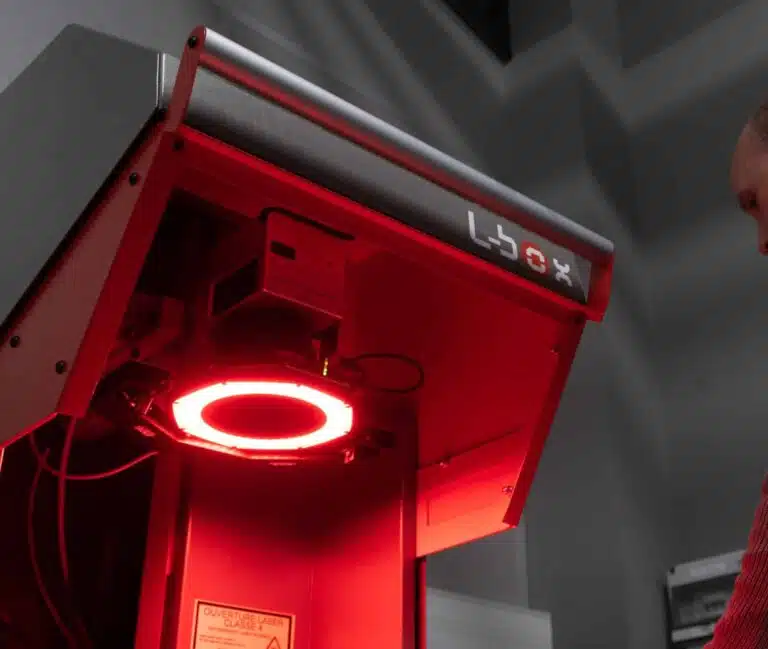
Discover our flagship equipment for laser marking, micro-percussion, or scribing marking, including our Portable Machines, Marking Modules Integrable on Production Lines, or Standalone Marking Stations.
Contact Us
Need information?
Get in touch with one of our experts!