Today, plastic parts play an essential role across a wide range of industries. From automotive to electronics, as well as medical, aerospace, and electrical equipment, engineering polymers are increasingly replacing metal materials thanks to their light weight, durability, and ease of processing.
Laser marking on plastic delivers permanent identification of every plastic part with no contact, no ink, and no consumables.
Depending on the material characteristics, the laser beam can produce a high-contrast mark, a surface engraving, or a perfectly legible color change, all while preserving the integrity of the part.
The quality of a plastic laser marking operation depends on many variables, however. The type of polymer (ABS, polycarbonate, polyamide, PEEK, PBT, POM…), the color of the material, the additives used, the mineral fillers or glass fibers, along with the performance of the laser system, all have a direct impact on the resulting contrast, code readability, and how well the mark holds up over time.
As a specialist in industrial marking solutions, SIC MARKING helps manufacturers define the technology best suited to their applications, backed by deep expertise in plastic materials and industrial traceability
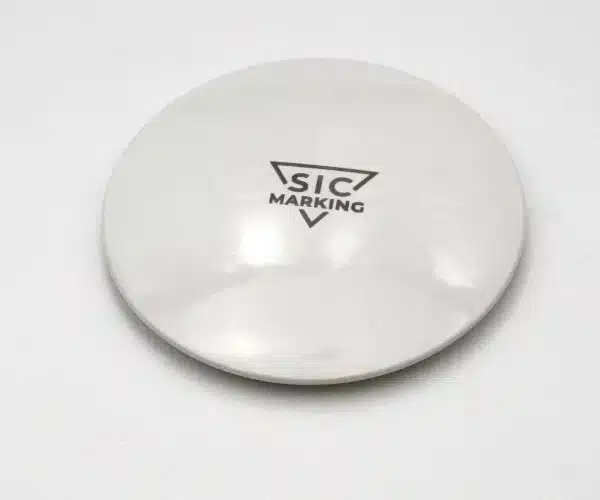
Laser marking on plastic meets these requirements by producing a permanent, precise mark embedded directly into the plastic part.
Unlike labels, inkjet printing, or attached tags, it requires no consumables and remains legible despite handling, cleaning cycles, or production-floor conditions.
Laser marking on plastic is compatible with a large number of polymers used in industry.
However, each material has physical and chemical properties that influence how it reacts to the laser beam.
The polymer composition, its color, the presence of mineral fillers or fibers, and the additives incorporated during manufacturing determine the resulting contrast, marking quality, and long-term durability.
With precise adjustment of the laser parameters, permanent marks can be produced on most engineering plastics used for industrial traceability.
The polymer formulation, pigments, dyes, glass fibers, mineral fillers, and specific additives all have a direct impact on the resulting contrast and the final quality of the mark.
That is why SIC MARKING performs marking trials to optimize the laser parameters for each application.
This validation phase guarantees the readability of Data Matrix codes, QR codes, serial numbers, and industrial logos while preserving the mechanical and cosmetic properties of the plastic parts.
Unlike metal materials, laser marking on plastic does not rely on a single physical phenomenon.
Depending on the nature of the polymer, its color, the pigments used, the additives present in the material, and the laser beam parameters, several mechanisms can be leveraged to produce a permanent mark.
The goal is always to achieve sufficient contrast to guarantee the readability of the marked information while preserving the mechanical and cosmetic properties of the part.
Depending on the target application, the laser can produce a color change, a foaming effect, a surface engraving, or coating ablation.
One of the key advantages of laser marking on plastic is its ability to produce high contrast, which is essential to guarantee the readability of the marked information. Depending on the nature of the polymer, its color, and its formulation, the laser can trigger a color change, a foaming effect, or a light engraving to produce a black, white, gray, or strongly contrasted mark.
Unlike printing or ink-based marking, the contrast comes directly from the material reacting to the laser beam. The result therefore depends on many parameters, including the plastic composition, the pigments used, the additives incorporated during manufacturing, and the laser system settings.
Drawing on its expertise in materials and industrial traceability, SIC MARKING helps manufacturers define the marking parameters best suited to each application. Preliminary trials optimize the resulting contrast and guarantee the readability of Data Matrix codes, QR codes, and other marked information, while preserving the mechanical and cosmetic properties of the plastic parts.
Laser marking on plastic provides permanent identification directly on the part, with no labels and no consumables.
Thanks to the fine spot size of the laser beam, both alphanumeric characters and complex 2D codes can be marked while maintaining excellent read quality.
Depending on production needs, the marked information supports the identification of plastic components, production tracking, quality control, and regulatory compliance. It can be read visually or automatically using machine vision systems and handheld scanners.
The terms plastic laser marking and plastic laser engraving are often used interchangeably. Yet they refer to two different processes that serve distinct objectives.
The choice depends primarily on the requirements of the application: cosmetic quality, target contrast level, marking depth, resistance to mechanical wear, and automated reading constraints.
Laser marking is generally the preferred option for industrial traceability, while laser engraving is chosen when material removal is required.
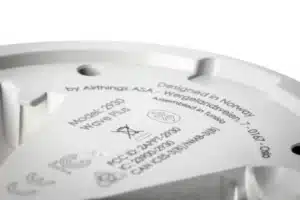
Contrast laser marking locally modifies the appearance of the plastic without removing any significant amount of material. Under the effect of the laser beam, the polymer surface changes color or structure to create visible contrast with the rest of the part.
The part geometry remains virtually unchanged, which is an advantage for precision components and cosmetic surfaces.
Thanks to the fine spot size of the laser beam, it produces highly precise marks, perfectly suited to automated reading systems and high-throughput production.
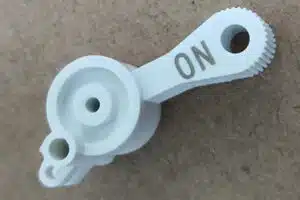
Plastic laser engraving works on a different principle. The beam removes a small amount of material to create relief of varying depth directly in the polymer.
The resulting depth depends on:
Engraving is particularly well suited when the mark must remain visible despite repeated friction, frequent cleaning, or heavy mechanical stress.
Laser engraving generally offers better wear resistance than a simple surface mark, but it alters the surface finish of the part to a greater degree.
In most industrial applications, contrast laser marking is the preferred solution for identifying plastic parts. It delivers an excellent level of readability while preserving the integrity of the material.
Laser engraving is reserved for applications that require a deeper mark or greater resistance to mechanical wear.
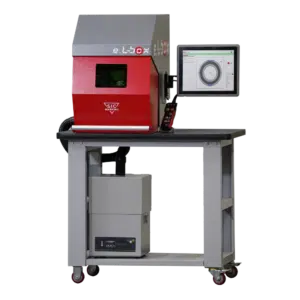
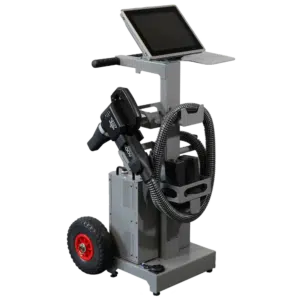
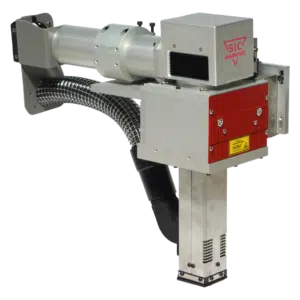
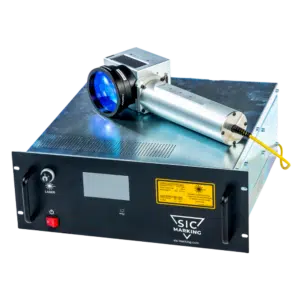
Take a look at our flagship laser marking equipment, including our Portable machines, Integrated modules for production lines, and Standalone marking stations.
Contact us
Need information?
Get in touch with one of our experts!