The European regulation on batteries introduces a major shift in identification and product data management.
Starting on February 18, 2027, certain categories of batteries will be required to be associated with a digital passport, accessible via a QR code directly marked on the product.
This requirement applies to industrial batteries over 2 kWh, light means of transport batteries (LMT) over 2 kWh, as well as electric vehicle batteries.
It is part of a broader framework focused on transparency, sustainability, and product circularity within the European Union.
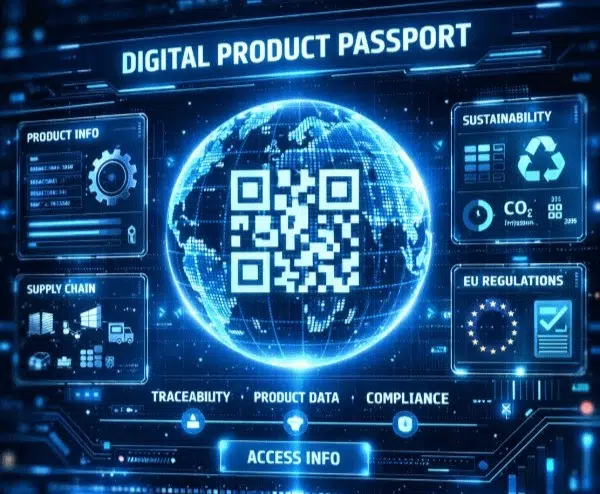
Within this new framework, the QR code is no longer limited to an identification function. It becomes the access key to the Digital Product Passport (DPP), as defined in Article 77 of the regulation.
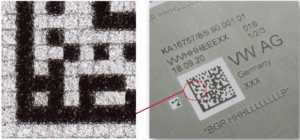
Each battery must therefore be marked in a visible, legible, and permanent manner with a QR code compliant with the requirements of Annex VI. This marking must be printed or directly engraved on the battery, ensuring durability in constrained environments exposed to thermal, chemical, and mechanical stress, often over long service lifetimes.
An exception is предусмотрed when direct part marking is not feasible or justified. In this case, the QR code may be applied to the packaging or accompanying documentation. However, in industrial applications and electric vehicle batteries, this exception remains difficult to implement in practice.
By 2027, any battery without a compliant QR code will no longer be allowed on the European market, making it a structuring requirement from the product design phase.
The Digital Product Passport is based on a three-level architecture that must operate consistently to ensure its effectiveness:
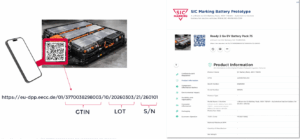
The QR code applied to the battery acts as an interface between the physical product and its digital environment. Once scanned—whether using a smartphone or an industrial reader—it redirects to a platform containing the passport data.
This includes identification data such as GTIN, batch number, or serial number, as well as technical, regulatory, and environmental information. This direct link between the product and its data ensures compliance with traceability and transparency requirements defined by the regulation.
Example of a DPP: https://eu-dpp.eecc.de/01/3770038298003/10/20260303/21/260101
In industrial environments, two types of 2D codes are commonly used: the DataMatrix and the QR code. The DataMatrix, typically square or rectangular with L-shaped finder patterns, has historically been preferred for direct part marking due to its compact size and its ability to remain readable on small surfaces.
The QR code, on the other hand, is always square and recognizable by its three positioning markers. It offers higher data capacity and is widely used in both consumer and industrial applications.
Within the battery regulation, the choice is explicit: the QR code is required. This regulatory requirement forces manufacturers to adapt their marking solutions accordingly.

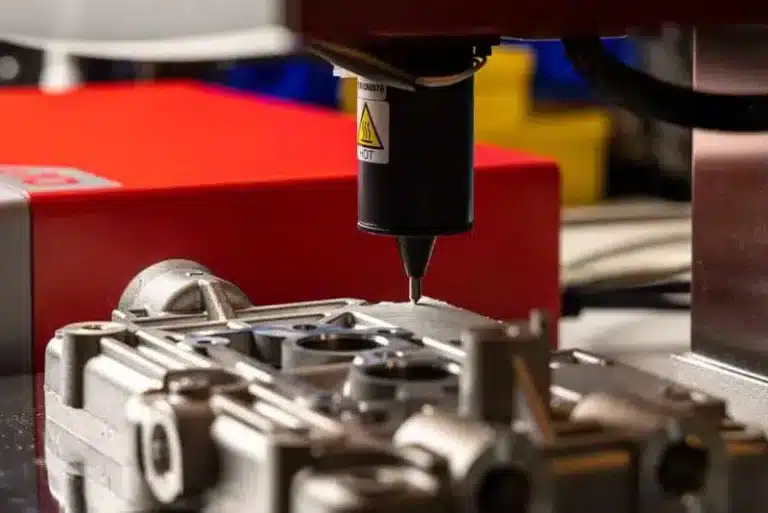
Several technologies are currently available to generate 2D codes on batteries. These include dot peen marking, scribing, electrochemical marking, inkjet, labels, and laser marking.
All these technologies can produce a marking, but they do not address industrial and regulatory constraints in the same way. Their relevance depends on several criteria: their ability to generate readable QR codes, capital investment, total cost of ownership, integration into production lines, marking permanence, and code readability quality.
Operating conditions are also critical. Markings must withstand external stresses such as abrasion, chemical exposure, wear, and harsh environments.
In this context, direct part marking technologies generally provide superior long-term durability.
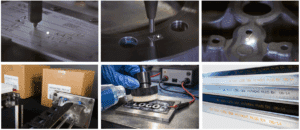
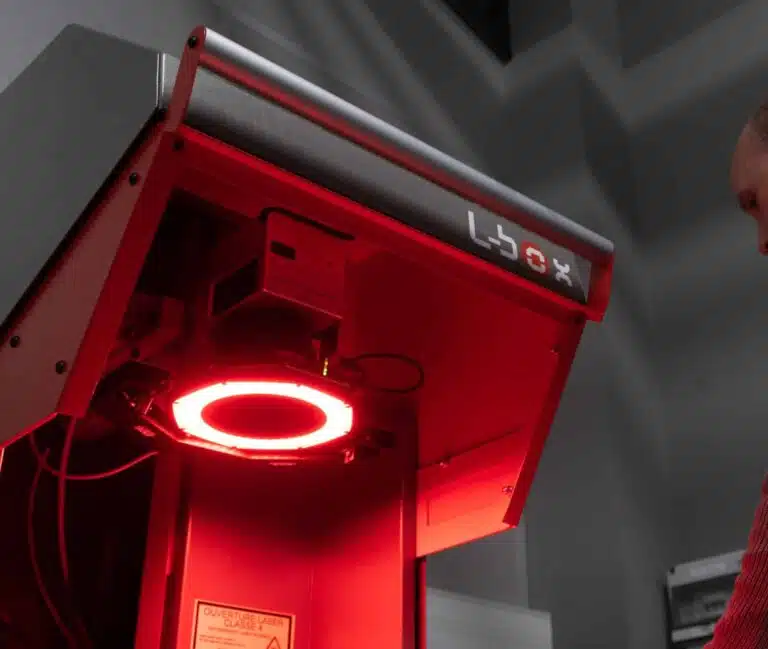
Among the available solutions, laser marking stands out for its ability to meet a wide range of constraints. This technology relies on a focused beam to modify the material surface through engraving, ablation, or contrast change.
One of its key advantages is its non-contact process. This enables marking of hard-to-reach areas while avoiding any mechanical stress on the part, which is particularly suitable for sensitive components.
Laser also offers high versatility across materials. In the battery environment—where aluminum, anodized or painted surfaces, engineering plastics, and conductive metals coexist—this adaptability is a major asset.
It enables the generation of readable, high-contrast, and durable QR codes on a wide range of substrates without the use of consumables.
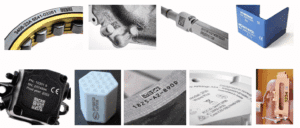
Aluminum is widely used in industrial batteries and electric vehicle batteries. Laser marking enables efficient processing of this material, whether raw or anodized:
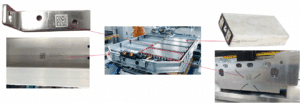
laser marking is used at multiple stages of the battery manufacturing process. It can be applied to cells—cylindrical, prismatic, or pouch-type—to ensure identification or prepare surfaces prior to assembly.
It is also used on busbars, where it ensures traceability of electrical connections between components. At the module level, it enables identification of complete subassemblies and the association of traceability data.
Finally, at the battery pack level, marking plays a central role, as it typically supports the regulatory QR code associated with the Digital Product Passport.
marking technologies, and in particular laser, can be directly integrated into production lines.
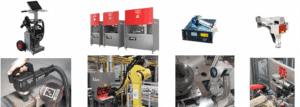
This integration can be achieved through customized stations, enclosed systems, or equipment mounted on robots or linear axes.
These solutions adapt to various production types, including industrial batteries, light mobility batteries, large battery systems, or small production runs.
battery marking is no longer limited to an internal traceability requirement. It is becoming a structuring regulatory requirement integrated from the product design phase.
The QR code, as the gateway to the Digital Product Passport, imposes high requirements in terms of readability, durability, and reliability. It must withstand time and harsh environments while ensuring reliable access to data.
Anticipating these requirements today ensures market access for batteries starting in 2027 and fully integrates traceability, sustainability, and circularity into industrial processes.
our solutions
Discover Our Products
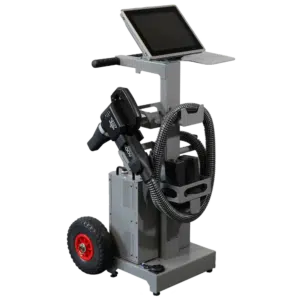
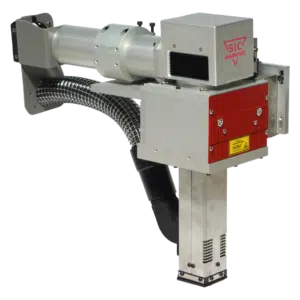
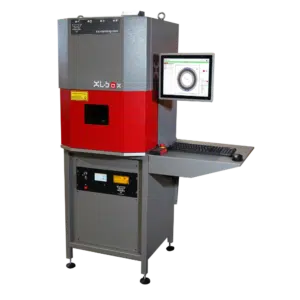
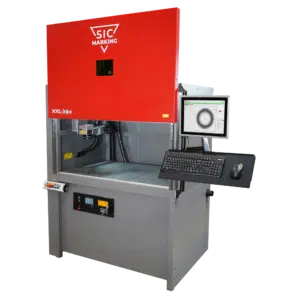
Explore our flagship equipment for laser marking, dot peen marking, and scribing, including portable machines, integrable modules for production lines, and standalone marking stations.
Want to learn more?
Contact us!